

GOAT Review
An animated treat stuck in a so-so basketball story.

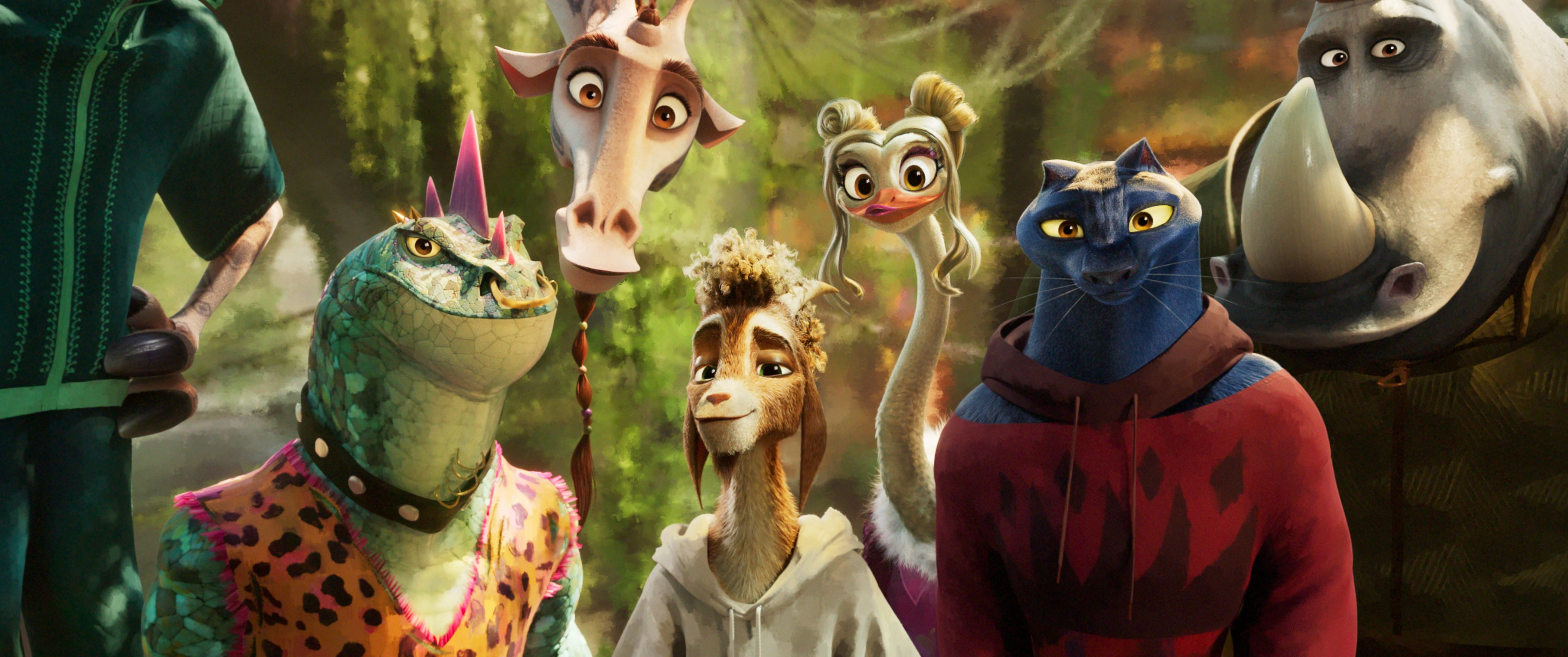
Hollywood is a funny old machine. You might as well think of it as a casino, a roulette wheel of gambles and choices where you hope Lady Luck shines your way for the jackpot. Sometimes, you win and take home all the accolades (and Oscars, if it makes it that far on that journey), and sometimes, it bombs spectacularly and sets unprecedented new records while doing so (keep on losing Melania). Yet such high stakes analogy feels apt for Tyree Dillihay and Adam Rosette’s GOAT.
To borrow an NBA term, it’s a draft pick that has come back to haunt Sony - the studio opting to trade KPop Demon Hunters to Netflix whilst banking on GOAT to ‘stack the deck’ for its roster. In a twist of whiplash fortunes and emotions, it’s KPop Demon Hunters that has grown into a global and award-winning juggernaut with its record-breaking streams, sold-out sing-along screenings and a long list of banging tracks (side note: whilst Golden is getting the accolades, the best song is What it Sounds Like. I have spoken). As for GOAT - for all the talent and animated feats it possesses - well, sadly, the bets are off, confirming they backed the wrong horse.
Given the groundbreaking standards Sony instilled with their Spider-Verse films and KPop Demon Hunters, GOAT is somewhat of a downgrade for the studio. It’s stuck between a rock and a hard place: an animation that once again delights as a visual spectacle, with all the fun and imagination you would expect from its hardworking animators, but wrapped around a basic, run-of-the-mill, Zootopia-lite story. It plays on the meme notion of GOAT, aka ‘The Greatest of All Time’, with an actual goat - Will Harris - who’s voiced by Stranger Things’ Caleb McLaughlin. Inspired by one of his favourite players - Jett Fillmore (Gabrielle Union), he dreams of one day playing Roarball, an NBA-inspired animal league. Problem is, he’s a “small”, a creature not expected to dominate a sport filled with the fastest and fiercest animals. To stress, there is nothing wrong with simple or straightforward narratives, and yet Aaron Buchsbaum and Teddy Riley’s script barely leaves first gear to elevate its inventive concept - and that’s deflating.
It’s a shame when GOAT’s potential aims high. It’s notably following in the footsteps of Space Jam (1996), a film that capitalised on Michael Jordan’s popularity for an epic team-up with Looney Tunes characters. Its 2026 counterpart boasts its own set of basketball legends, including Golden State Warriors Stephen Curry (voicing Lenny the giraffe and serving as producer), Angel Reese, Dwayne Wade, Kevin Love, A’ja Wilson and Andre Iguodala. That collective expertise lends weight and credibility for Will’s growth and journey, from his ‘Dream Big’ persona (a mantra he writes on his sneakers), the ‘Small Goat Can’t Jump’ face-off with stallion Mane Attraction (Aaron Pierre), before going viral and getting the rookie call-up for the Thorns.
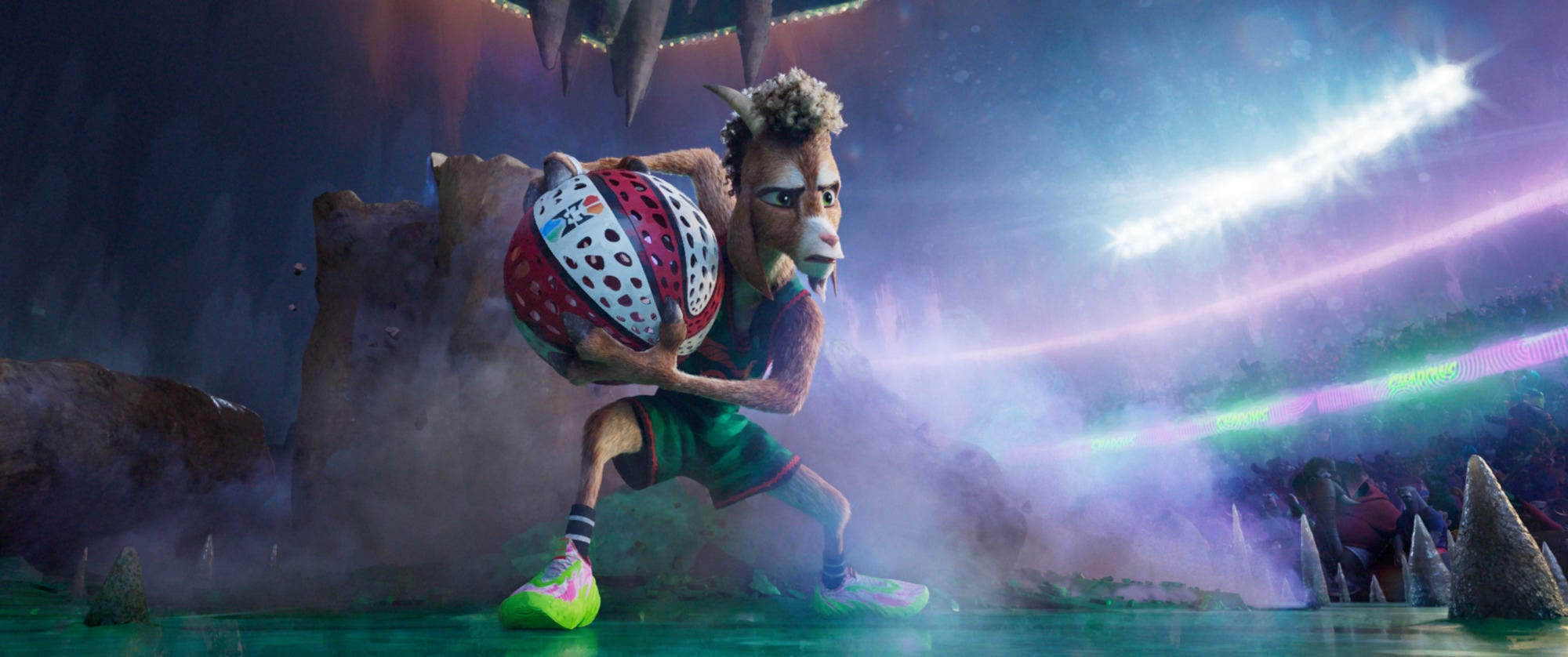
Aside from its celebrity endorsements and its faithful recreation of NBA culture, Dillihay and Rosette’s film also grapples with the price of stardom and what happens when a basketball star is forced to reconcile with their career. It’s found in Jett, the Thorns’ notorious ‘ball hog’ star player, who shows growing anger and frustration that there’s a goat on their team while also dealing with the noise that the star may be past their prime. It also acknowledges the impact of fans and how a sports franchise inspires a community, as illustrated by one heartwarming scene where Will takes Jett to Vineland to the diner where he used to work. “Roots run deep” as the film defiantly calls, and in Will sharing his story, it begins to break down Jett’s defences.
With a good inspirational message at its core, that should be sufficient material to play with, and yet the problem is frank: the film’s light approach always finds itself rushing, never fully taking advantage of its animal worldbuilding or its characters. These characters exist only at their basic level without many challenges or shifts to their personality. Even when it does arrive, it’s brushed off for the next hurdle it wants to face.
There is a simple argument that could be deciphered here: this is aimed at young audiences, and therefore, it’s a plot that doesn’t require deeper thinking. But as animation has always proved, it’s brave enough to explore those subjects, often with an unapologetic boldness, something that GOAT clearly wants in mimicking the ‘Spider-Verse’ style. Sadly, this doesn’t trust its audience enough to take that leap; it would rather handhold us through its underdog convention and play it safe. One can’t help but wonder whether the resources were diverted away for the mammoth task of completing the final Spider-Verse film. But whatever the reason, it occasionally leaves GOAT incomplete and unfinished, with some moments perhaps left on the cutting room floor.
But at least the animators had fun. They are undoubtedly the star of the show, where their heavylifting provides plenty of visual humour. Not all of the jokes land, but they do enough to keep it within game. Its best moments are the Roarball court environments: the Thorns have the jungles, the Shivers have polar ice caps, while team Magma lives up to their name with volcanic lava erupting throughout the court. When they say “the court is a battlefield”, to borrow a very famous Michael Jordan meme, the animators took that personally and made this a worthwhile adventure.
GOAT is not the slam-dunk it wants to be, but it does enough within its arsenal to be charming nevertheless. Just manage your expectations heading into this one.
Rating: ★★★